


GNS ONLINE NEWS PORTAL
SHAFQAT SHEIKH
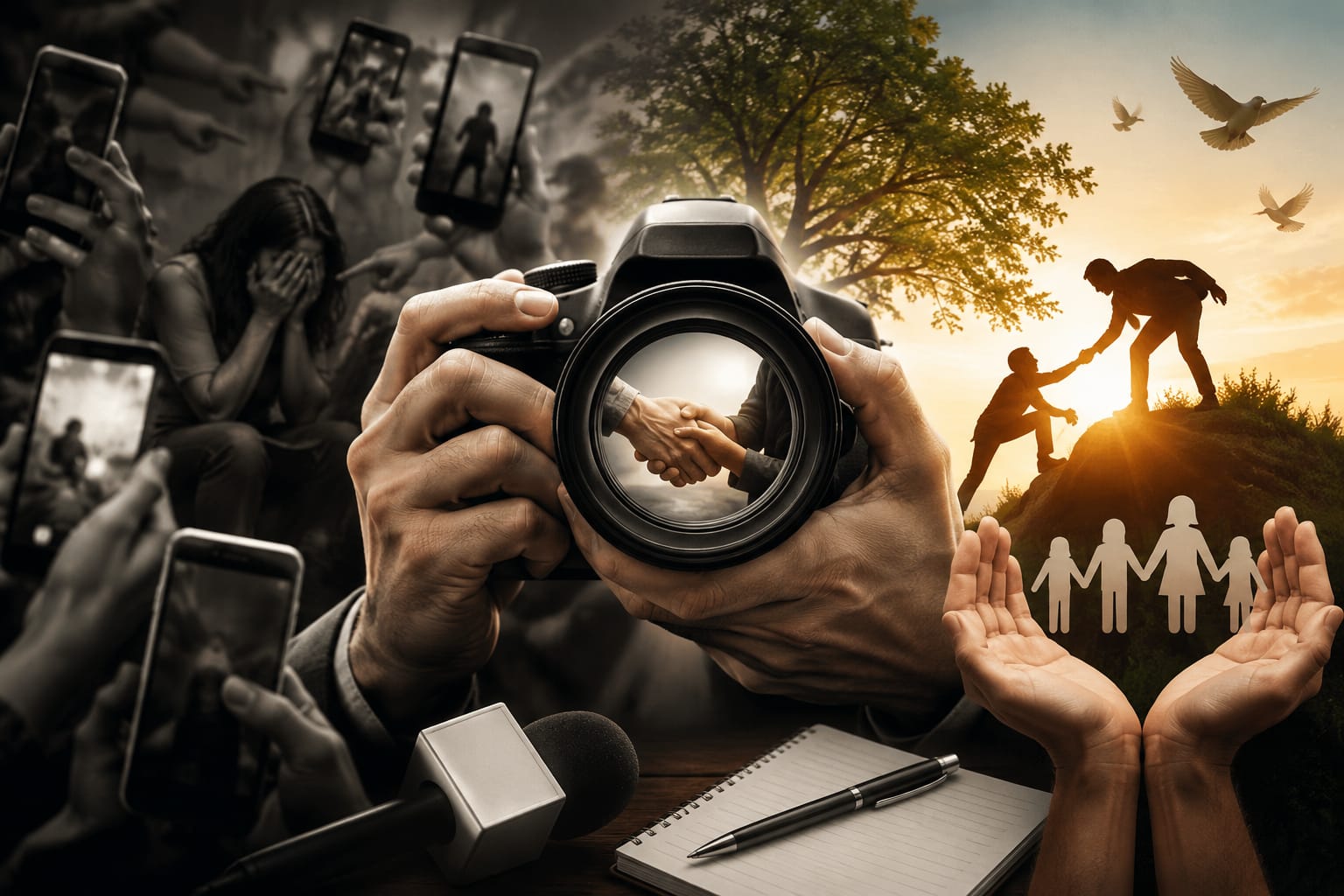
In an age where almost every smartphone has become a camera and every social media page claims to be a news platform, journalism is facing an important question: What does it really mean to be a journalist?
Across erstwhile Doda District and other parts of Jammu and Kashmir, many social media pages are performing an important public service. They highlight neglected roads, shortages of drinking water, electricity problems, failures in healthcare, the absence of doctors, educational concerns and other issues affecting ordinary people. Such local journalism can play a valuable role in giving a voice to communities that are often ignored by mainstream media.
However, alongside this positive work, an unhealthy trend is also emerging. Some individuals appear to believe that possessing a mobile phone, a camera and a social media page gives them the authority to investigate, prosecute, judge and publicly punish people.
Allegation Is Not Proof: One of the most dangerous practices in social media reporting is the public broadcasting of unverified allegations against individuals. A person comes before a camera and calls someone a thief, dishonest, criminal or drug user. The allegation is recorded and circulated among thousands of people. The accused person’s name and identity may be exposed, and his reputation may be severely damaged.
Then, after everything has already been broadcast, the page adds a disclaimer: “We do not endorse the viewpoint of this person.”
But can such a disclaimer undo the damage?
By the time the accused person gets an opportunity to respond, the allegations may already have travelled across social media. His family, friends, neighbours and colleagues may have seen the video. His dignity may have been publicly attacked before any competent authority has examined the facts. A disclaimer cannot automatically transform an unverified allegation into responsible journalism. An allegation remains an allegation until it is properly verified or established through the appropriate legal process.
Journalists are not judges: They are not police officers. They cannot declare a person guilty merely because someone has made an accusation before their camera. Responsible journalism requires verification, fairness, accuracy and, wherever appropriate, an opportunity for the other side to respond.
When Humanity Comes Before the Camera: Another serious question concerns the role of journalists when they witness violence or a person facing immediate danger. Various incidents are being now reported on social media sites where alleged assault and other things are happened. Journalists and social media reporters subsequently reached the location and recorded videos. There have also been different claims regarding what happened at the scene, including allegations concerning the conduct of individuals present and cross checked by authorities. No conclusion should be drawn about the responsibility of any particular individual without proper examination of the evidence.
But the broader question remains:
*If a journalist witnesses a person being brutally assaulted, is his first responsibility to record the incident—or to help protect the person in danger?*
The answer should be clear. A journalist is not merely a camera operator. Before being a reporter, he or she is a human being and a responsible member of society. Of course, no journalist should unnecessarily endanger himself or herself, nor take the law into their own hands. But where it is reasonably safe to do so, immediate steps should be taken to protect the victim, call for help, alert the police or emergency services, and seek assistance from people nearby. Recording evidence may be important. But recording suffering while ignoring an opportunity to prevent further harm raises a serious moral question.
*The camera should not become more important than human life*.
Journalism Is Not a Panchayat of Allegations:
Social media journalism increasingly risks becoming a virtual Panchayat Ghar, where one person arrives, makes allegations, and is given a platform. Then another person comes and presents counter-allegations. Videos are uploaded, reactions are collected, and public opinion becomes the judge.
But journalism is not supposed to be an uncontrolled forum for accusation and humiliation. Journalism has principles. It has ethical standards and responsibilities.
These questions should come before the record button is pressed and before the publish button is clicked.
The Real Purpose of Local Journalism:
Local journalism has an important mission. Communities need reporters who can highlight genuine public issues: broken roads, unsafe bridges, irregular water supply, electricity failures, inadequate health facilities, absentee staff, poor educational infrastructure and failures in public administration. These are matters where journalism can genuinely serve society. *A strong local journalist can become the voice of a neglected village. A factual report can force authorities to respond. A carefully documented story can expose administrative failures and help bring about change*.
But that power must not be misused.
The purpose of journalism should not be to generate views by humiliating individuals. It should not be to convert personal allegations into public verdicts. Nor should it be to stand silently behind a camera when a person is facing immediate danger and assistance can reasonably be provided.
Responsibility Must Come With the Platform: No one is questioning the right of social media pages to report news. In fact, responsible digital journalism has become an essential part of modern public life. But the larger the audience, the greater the responsibility.
Freedom of expression does not mean freedom from responsibility. The speed of social media does not remove the need for verification. A viral video does not establish guilt. And a disclaimer does not necessarily erase the consequences of broadcasting damaging and unverified accusations.
*Every reporter—whether formally trained or working independently—must understand one fundamental principle: The power to publish is also the responsibility to publish carefully*.
A Personal Reflection
For the last several years I have not been working regularly with a particular Media house in the same manner as before. I have stepped back from day-to-day involvement, although I continue to share important update and matters of public concern through my profile or to take issue with concerned authorities whenever necessary. This should not be misunderstood as a complete break or hostility between me and Media organisations. That is not the case.
My concern today is broader than any single organisation, page or individual. It is about the direction in which social media journalism is moving.
“We need more journalism that investigates—but does not prejudge.
We need more reporting that exposes problems—but does not humiliate people without proof.
We need more cameras documenting the truth—but not cameras that become indifferent to human suffering.
And above all, we need reporters who remember that before they are journalists, they are human beings”.
The Final Question: The future of journalism will not be decided by who has the most followers, the fastest uploads or the most viral videos. It will be decided by whether those who hold cameras and control platforms use that power with truth, fairness, restraint and responsibility.
*Do not become the judge. Do not become the police. Do not turn allegations into convictions. Verify before publishing. Give the other side a fair opportunity to respond. Respect human dignity. And when a life is in immediate danger, remember that the first duty is not always to capture the moment—it may be to help save the person*.
That is not weakness. That is responsible journalism.
( The author is a Freelance Writer Columnist from Bunjwah Kishtwar and can be reached at freelancershafqat@gmail.com 9419974577, 9419281321).

 Users Today : 57
 Users Yesterday : 140
 Users Last 7 days : 409
 Users Last 30 days : 409
 Users This Month : 409
 Users This Year : 409
 Total Users : 410
 Views Today : 76
 Views Yesterday : 201
 Views Last 7 days : 575
 Views Last 30 days : 575
 Views This Month : 575
 Views This Year : 575
 Total views : 576
 Who's Online : 0