


GNS ONLINE NEWS PORTAL
_Stresses need to balance economic growth with environmental protection; backs sustainable mountain development policy for JK_
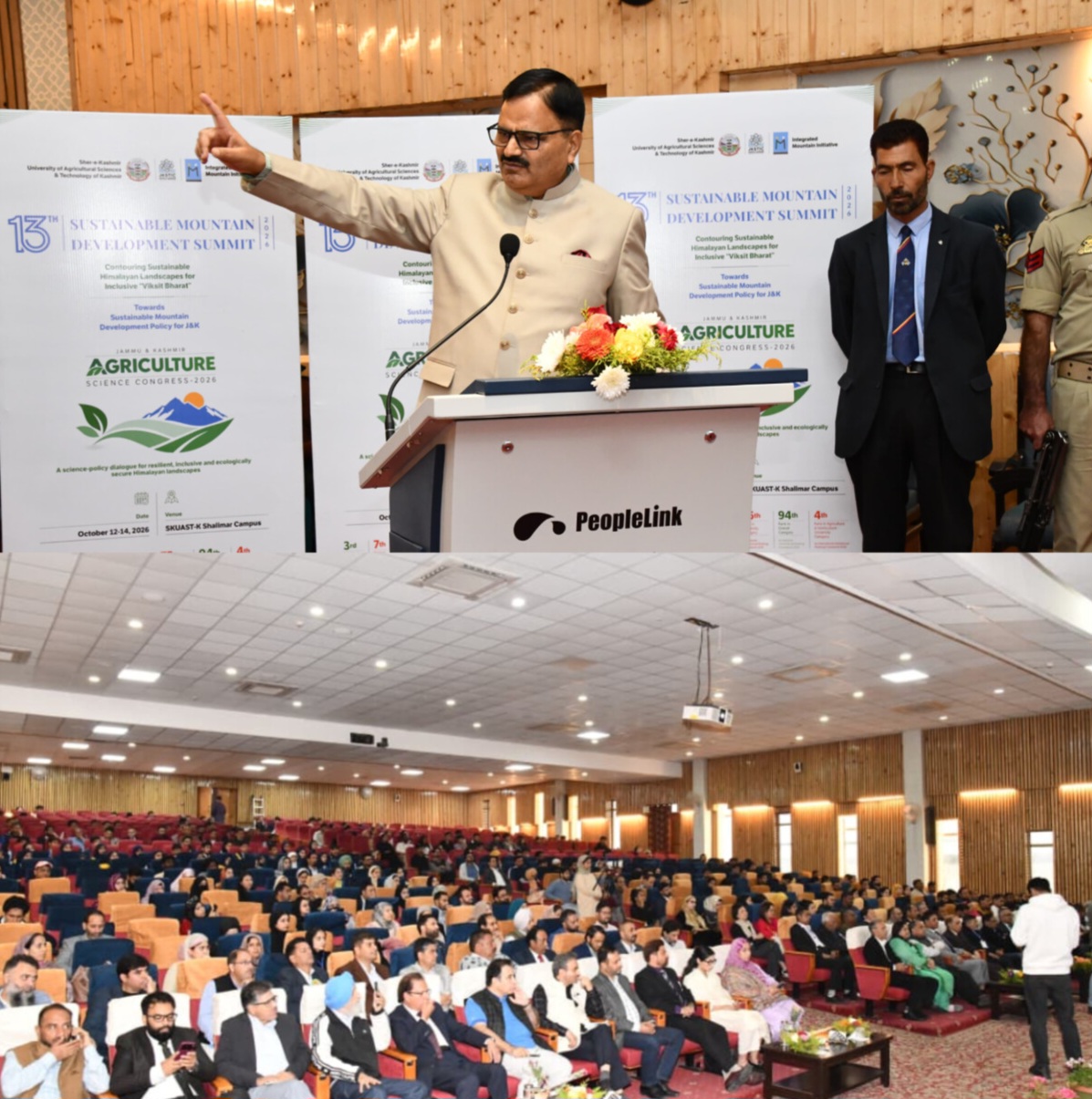
SRINAGAR, OCTOBER 14:- Minister for Jal Shakti, Forest, Ecology & Environment and Tribal Affairs, Javed Ahmed Rana, today underscored the need to place water security, forest conservation and ecological sustainability at the heart of the Himalayan development agenda, asserting that the long-term prosperity of Jammu and Kashmir depends on striking a judicious balance between economic growth and environmental protection.
The Minister was speaking at the 13th Sustainable Mountain Development Summit (SMDS) 2026, held at the Shalimar campus of Sher-e-Kashmir University of Agricultural Sciences and Technology of Kashmir (SKUAST-Kashmir).
The three-day summit, being held from October 12 to 14, is organised by SKUAST-Kashmir in collaboration with the Integrated Mountain Initiative (IMI), bringing together scientists, policymakers, civil society representatives and community leaders from across India’s mountain regions to deliberate on the challenges and opportunities shaping sustainable Himalayan development.
Addressing the gathering on the theme, “Contouring Sustainable Himalayan Landscapes for Inclusive Viksit Bharat,” Rana described the theme as both timely and consequential, particularly in the context of the growing need to reconcile development aspirations with the ecological sensitivities of mountain regions.
He stressed that Jammu and Kashmir requires a development framework that promotes economic opportunities, strengthens local livelihoods and improves public services without compromising the natural systems that sustain life in the Himalayas.
The Minister observed that the Himalayas are far more than a geographical entity, describing them as a vital ecological lifeline that sustains millions of people and supports the environmental well-being of vast regions beyond the mountains.
He noted that forests, glaciers, rivers, springs and rich biodiversity collectively underpin agriculture, horticulture, tourism and other livelihood activities, while regulating water flows, maintaining ecological balance and supporting the region’s natural resilience.
Emphasising the centrality of water security to sustainable mountain development, Rana said, “Water security must remain one of our foremost priorities.” He called for a comprehensive and long-term approach to water resource management, with particular emphasis on the protection and rejuvenation of springs, conservation of catchment areas, promotion of rainwater harvesting, improvement in water-use efficiency and safeguarding the sustainability of drinking water sources.
He stressed that the expansion of water supply infrastructure must go hand in hand with the conservation and replenishment of natural water resources. According to the Minister, ensuring reliable and equitable access to safe drinking water requires not only the creation of infrastructure but also the protection of the ecosystems that sustain rivers, springs and groundwater sources.
“While expanding water supply infrastructure, equal emphasis must be laid on the conservation and replenishment of natural water resources that sustain these systems. A sustainable approach to water management is essential to ensure reliable access to drinking water for communities while preserving the ecological balance of the Himalayan region,” he added.
Highlighting the intrinsic relationship between forests, water resources and ecological stability, Rana stressed that forest conservation must remain an integral component of the region’s development strategy. He observed that healthy forests and well-managed catchment areas are essential for sustaining water sources, protecting biodiversity, reducing land degradation and strengthening the resilience of mountain communities against environmental challenges.
The Minister also emphasised the importance of adopting a mountain-sensitive approach to planning and infrastructure development, taking into account the region’s fragile ecology, terrain, natural resource constraints and vulnerability to disasters. He said development interventions must be guided by long-term sustainability, scientific assessment and the needs of local communities to ensure that economic progress translates into lasting public benefit.
Rana expressed particular encouragement over the deliberations on the proposed Jammu and Kashmir Sustainable Mountain Development Policy, whose first draft has been jointly developed by IMI and SKUAST-Kashmir and is currently being reviewed by national experts. He described the initiative as an important step towards establishing a coherent policy framework that integrates ecological conservation, sustainable resource management and inclusive economic development.
The proposed policy places emphasis on ecological carrying capacity, mountain-sensitive land-use planning, responsible tourism, resilient infrastructure, effective waste management, watershed and spring security, disaster-risk reduction and sustainable mountain livelihoods.
The ongoing summit provides a platform for expert consultations and inter-governmental deliberations to examine these priorities, incorporate diverse perspectives and further refine the policy framework.
Stressing that sustainable development must be measured by its tangible impact on people’s lives, the Minister said, “The real measure of development is not simply the number of projects completed, but the quality of life we secure for our people and the natural heritage we preserve for future generations.”
He called for a development model that places people and the environment at its core, ensuring that economic advancement does not come at the cost of ecological degradation. He emphasised that every village must have access to safe drinking water, forests and biodiversity must be safeguarded, and young people must be provided with opportunities to pursue sustainable livelihoods within their own regions.
The Minister further stressed the importance of community participation, institutional coordination and collective responsibility in achieving sustainable mountain development. He said that local communities, scientific institutions, policymakers and civil society must work together to protect fragile ecosystems, promote responsible resource use and build resilient mountain economies that can withstand emerging environmental and developmental pressures.
Expressing confidence in the outcomes of the summit, Rana said the deliberations would generate practical and forward-looking ideas, strengthen institutional partnerships and contribute to a clear roadmap for the sustainable, inclusive and climate-resilient development of Jammu and Kashmir and the wider Himalayan region.
He called upon all stakeholders to renew their collective commitment to protecting the mountains, conserving water resources, safeguarding forests and biodiversity, and empowering communities as active partners in the development process.
The Minister extended his best wishes to the organisers, experts and participants, expressing hope that the summit would translate its deliberations into meaningful policy recommendations and actionable strategies for securing a sustainable future for the Himalayan region.

 Users Today : 33
 Users Yesterday : 140
 Users Last 7 days : 385
 Users Last 30 days : 385
 Users This Month : 385
 Users This Year : 385
 Total Users : 386
 Views Today : 48
 Views Yesterday : 201
 Views Last 7 days : 547
 Views Last 30 days : 547
 Views This Month : 547
 Views This Year : 547
 Total views : 548
 Who's Online : 0