


GNS ONLINE RAJOURI
SHYAM SOOD
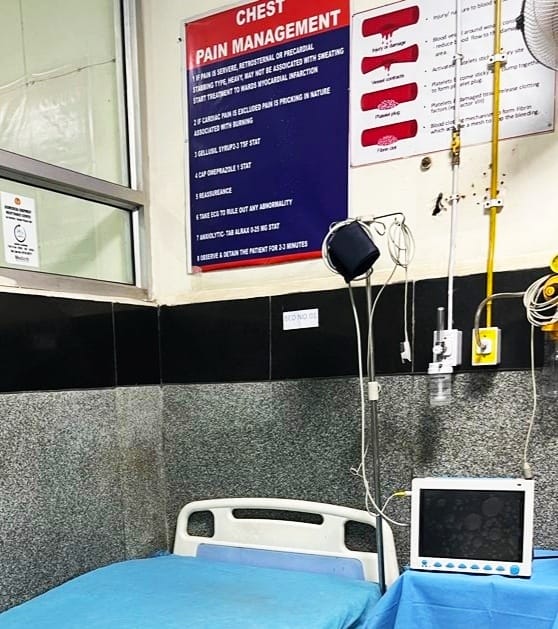
RAJOURI, JULY 27:—In a significant achievement, Associated Hospital Government Medical College (AHGMC) Rajouri saved the lives of 28 heart attacks (Myocardial Infarction) patients in the months of May & June 2023.
“These patients were managed after timely providing treatment as per protocol, including Thrombolysis, during the golden hours in AHGMC’s dedicated Thrombolysis lounge,” said Medical Superintendent AHGMC, Dr. Mehmood Hussain Bajar.
Thrombolysis (Thrombolytic therapy) uses medications or a minimally invasive procedure to break up blood clots and prevent new clots from forming.
Myocardial infarction (MI), colloquially known as ‘heart attack’ is caused by decreased or complete cessation of blood flow to a portion of the myocardium (heart muscle).
Myocardial infarction may be ‘silent’, and go undetected, or it could be a catastrophic event leading to hemodynamic deterioration and sudden death.
A heart attack happens when there is a loss of blood supply to part of the heart muscle. It often results from a blockage in a nearby artery.
A person who is experiencing a heart attack or myocardial infarction will feel pain in their chest and other parts of their body, as well as other symptoms.
“Spotting the early signs of a heart attack and getting prompt treatment is crucial and can save a person’s life. A heart attack is different from cardiac arrest, in which the heart stops working completely. Both are medical emergencies, and without treatment, a heart attack can lead to cardiac arrest,” said Dr. Mehmood.
As heart attacks can be fatal, it is crucial to recognize the warnings as soon as possible and contact emergency services.
The first hour after the onset of a heart attack is called the golden hour. Appropriate action within the first 60 minutes of a heart attack can reverse its effects. This concept is extremely important to understand because most deaths and cardiac arrests occur during this period.
However, if the person reaches the hospital and gets treated within this period he/she can expect near-complete recovery.
The most common serious symptoms of a heart attack a patient can feel/recognise include a feeling of pressure, tightness, and pain, squeezing, or aching in the chest, pain that spreads to the arms, neck, jaw, or back, a feeling of crushing or heaviness in the chest and heartburn or indigestion, sickness and sometimes vomiting with a feeling of clammy and sweaty, shortness of breath and feeling lightheaded or dizzy.
In some cases, anxiety can feel similar to a panic attack, coughing or wheezing, if fluid builds up in the lungs, hypoxemia (low levels of oxygen in the blood); Pulmonary edema (fluid accumulating in and around the lungs).
Carcinogenic shock involves blood pressure dropping suddenly because the heart cannot supply enough blood for the rest of the body to work adequately.





 Users Today : 117
 Users Yesterday : 770
 Users Last 7 days : 3295
 Users Last 30 days : 7933
 Users This Month : 4782
 Users This Year : 8145
 Total Users : 8146
 Views Today : 126
 Views Yesterday : 1017
 Views Last 7 days : 4595
 Views Last 30 days : 12577
 Views This Month : 6976
 Views This Year : 12875
 Total views : 12876
 Who's Online : 4