GNS ONLINE NEWS PORTAL
ALTAF HUSSAIN
RAJOURI-POONCH JAN,14:-The ongoing debate over the proposed National Law University in Jammu and Kashmir has once again brought to the fore a deep-rooted issue of regional imbalance. While public and political discourse remains limited to whether the institution should be established in Jammu or Kashmir, the continued exclusion of the Pir Panjal region from this crucial discussion has exposed decades of institutional neglect suffered by the people of Rajouri, Poonch, and adjoining areas.
This persistent silence, activists argue, is neither incidental nor new—it reflects a pattern of marginalisation spanning more than seventy years.
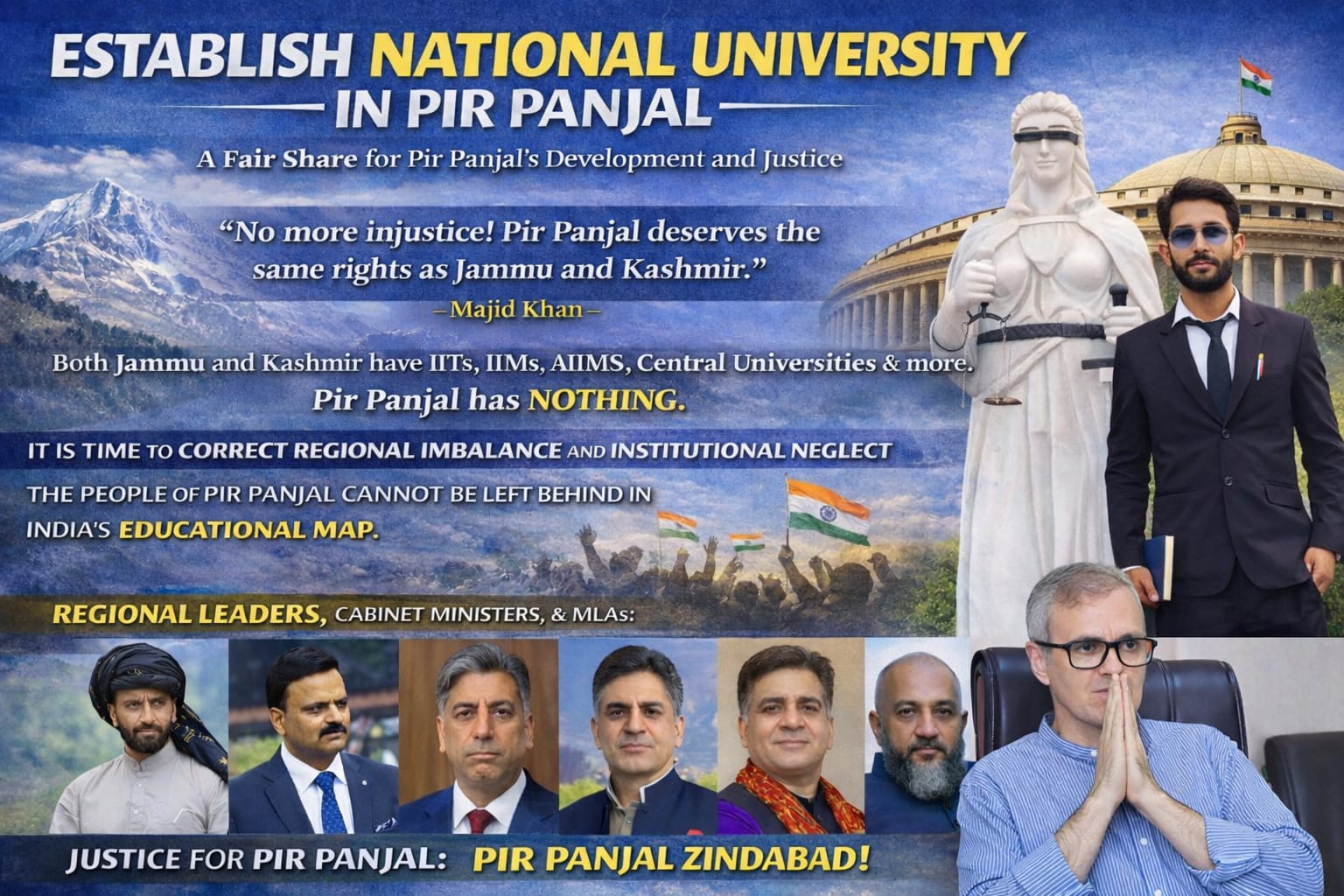
Social activist Majid Khan has expressed serious concern over what he termed the “passive and ineffective” approach of political leadership from the Pir Panjal region. He stated that elected representatives have failed to assert a clear, united, and principled demand for Pir Panjal, despite being entrusted with the mandate to safeguard the region’s interests.
“The people of Pir Panjal are repeatedly asked to elect their representatives, but when critical decisions on education and development are taken, the region is conveniently forgotten,” Khan said. He questioned why leaders hesitate to firmly state that Pir Panjal also deserves a National Law University on the same grounds of merit, need, and equity that are cited for Jammu and Kashmir.
Over the last seven decades, both Jammu and Kashmir regions have benefitted significantly from the establishment of premier national institutions and infrastructure. Jammu hosts institutions such as IIT, IIM, AIIMS, and multiple universities, while Kashmir has similarly received IIT, AIIMS, a Central University, private universities, and substantial industrial and agricultural support.
In stark contrast, Pir Panjal remains without a single Central or Cluster University. Even the existing university structure in the region is facing administrative uncertainty, raising serious concerns about the academic future of thousands of local students.
Majid Khan stressed that this imbalance is in direct contradiction to the constitutional principles of equality, social justice, and balanced regional development. “The denial of higher educational institutions to Pir Panjal cannot be justified on legal, moral, or developmental grounds. The Constitution of India envisions inclusive growth and equal opportunities, especially for geographically challenging and historically underdeveloped regions,” he said.
He further emphasized that establishing a National Law University in Pir Panjal would be a transformative step. Such an institution would provide access to quality legal education for local youth, reduce forced migration to distant regions, generate employment, strengthen the local economy, and promote national integration by attracting students from across the country.
“This is not just about Pir Panjal. It is about the overall progress of Jammu and Kashmir and the nation,” Khan added.
Calling for collective political responsibility, Majid Khan urged the Member of Parliament, Cabinet Ministers, Members of the Legislative Assembly from Rajouri and Poonch, and leaders across party lines to rise above partisan interests and jointly present Pir Panjal’s case at the highest levels of governance, including New Delhi. He warned that continued silence and disunity would only deepen public resentment and perpetuate historical injustice.
He also appealed to civil society organisations, non-governmental groups, intellectuals, social activists, and youth to unite behind a common, non-political demand for the establishment of a National Law University in Pir Panjal. “Only a united, sustained, and principled voice can ensure that our legitimate aspirations are heard,” he said.
The demand for a National Law University in Pir Panjal, activists assert, is not a plea for special treatment, but a rightful claim rooted in justice, constitutional values, and national interest. The time, they say, has come to correct decades of neglect and ensure that Pir Panjal finally receives its due place in India’s educational and developmental landscape.











 Users Today : 354
 Users Yesterday : 165