


GNS ONLINE NEWS PORTAL
SHAFQAT SHEIKH
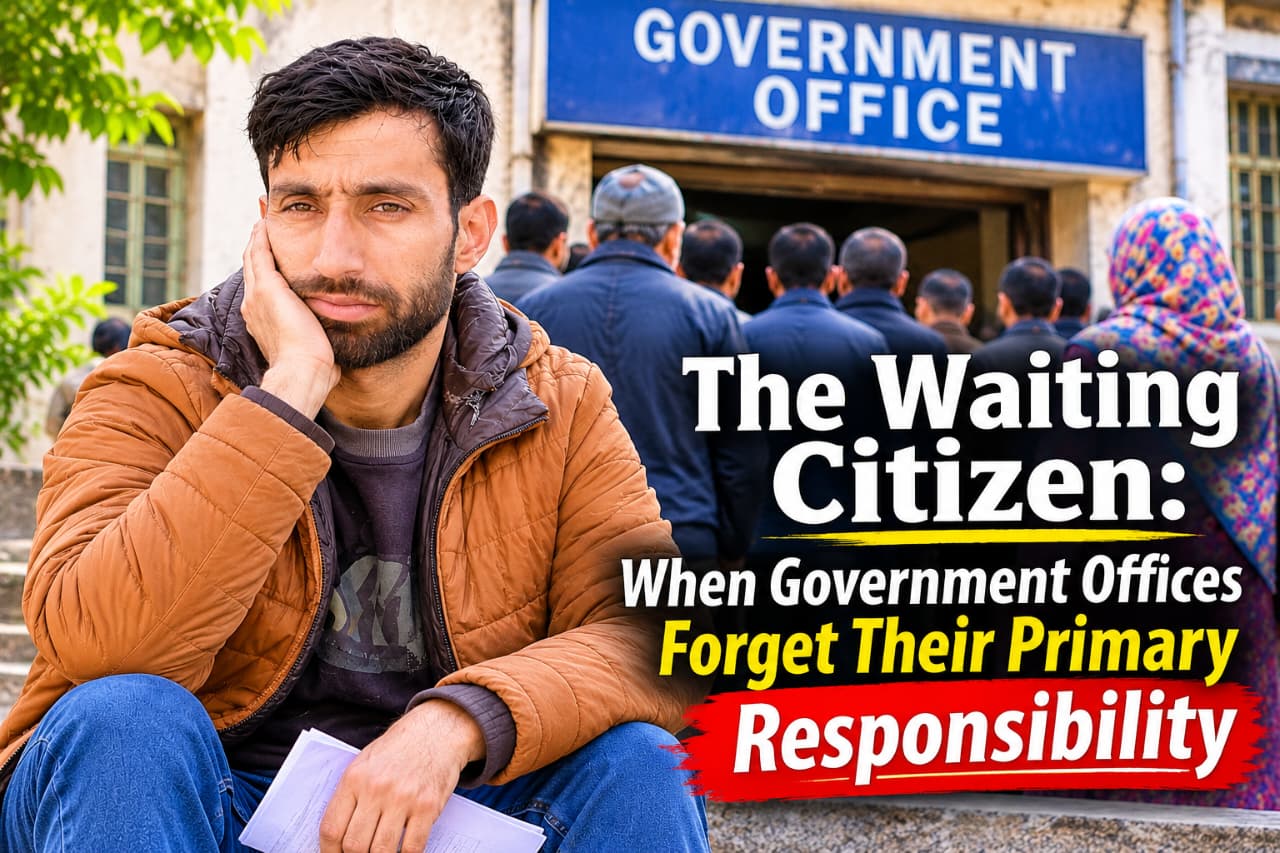
CHENAB VALLEY NOV 04:-A government office is meant to be a place where citizens seek solutions to their problems, present their grievances and expect justice through established administrative mechanisms. Unfortunately, for many ordinary people, approaching a government office has increasingly become an exhausting experience, marked by prolonged waiting, uncertainty and, at times, a disappointing lack of response.
The experience of spending more than three hours outside an officer’s office, waiting for an opportunity to submit a representation and explain a genuine grievance, raises an important question about the accessibility and accountability of our administrative institutions. How much time should an ordinary citizen be expected to waste simply to be heard by an officer whose primary responsibility is public service?
Time is precious, and once lost, it can never be recovered. For people travelling from remote and rural areas to district headquarters, such delays are even more burdensome. They often spend money on transportation, sacrifice their daily earnings and travel considerable distances with the hope that someone in authority will listen to their concerns. Returning home without even getting an opportunity to present a representation can be deeply discouraging.
“Endless waiting, inaccessible officers and administrative indifference are eroding public confidence. It is time to make grievance redressal citizen-centric, transparent and time-bound”
An officer’s chair is not merely a symbol of administrative authority; it represents public trust, responsibility and accountability. Holding a position in government comes with an obligation to remain accessible to the people, particularly those who have limited resources and no influential connections.
There is also a growing perception among sections of the public that preferential treatment, unnecessary bureaucratic hurdles and alleged corrupt practices, including palm-greasing, sometimes influence access to administrative authorities. Such perceptions, whether established in individual cases or otherwise, deserve serious attention because public confidence in governance depends not only on actual performance but also on transparency and fairness.
The government must introduce a structured and time-bound public grievance-hearing mechanism across district-level offices. A reasonable standard should be established whereby citizens are ordinarily given an opportunity to meet the concerned officer within 30 minutes of their scheduled or acknowledged arrival. In cases where an officer is occupied with urgent official responsibilities, the applicant should be informed and provided with an alternative time without unnecessary inconvenience.
A designated public grievance hour, a token-based appointment system, proper visitor registers and monitoring of pending representations could make the process more transparent and effective. Citizens should also have the facility to submit their applications through an authorised receiving official and obtain an acknowledgement, rather than waiting indefinitely for a personal audience.
The administration must particularly consider the difficulties faced by people from far-flung areas of mountainous districts such as Kishtwar, where geographical barriers, limited public transport and financial constraints already make access to government institutions challenging.
Good governance cannot be measured merely by the number of meetings conducted, files processed or official orders issued. Its real success lies in how effectively the administration responds to the concerns of an ordinary citizen.
A poor farmer, a daily-wage labourer, an unemployed youth or an elderly person may not have political influence or personal connections, but every one of them has an equal right to be heard with dignity.
Public service is not a privilege granted by an officer; it is a responsibility entrusted to them by the people.
The government must ensure that no citizen is compelled to spend hours outside a closed office simply to seek an opportunity to explain a genuine grievance. An accessible administration, a patient hearing and a timely response can go a long way towards restoring people’s faith in the system.
Ultimately, the measure of an officer’s public service should not be the number of people waiting outside their office, but the number of grievances addressed with fairness, sincerity and accountability.
A citizen approaches a government office with hope. The administration must ensure that the citizen does not leave with disappointment.
The author is a Freelance Writer Columnist from Bunjwah Kishtwar and can be reached at freelancershafqat@gmail.com , 9419974577, 9419281321).




 Users Today : 276
 Users Yesterday : 314
 Users Last 7 days : 2492
 Users Last 30 days : 4504
 Users This Month : 1141
 Users This Year : 4504
 Total Users : 4505
 Views Today : 452
 Views Yesterday : 524
 Views Last 7 days : 3974
 Views Last 30 days : 7769
 Views This Month : 1870
 Views This Year : 7769
 Total views : 7770
 Who's Online : 1